The Denarii of Vespasian
The Denarii of Vespasian, Minted in Rome (AD 69–79): An Illustrated Corpus with Typology and Legends.
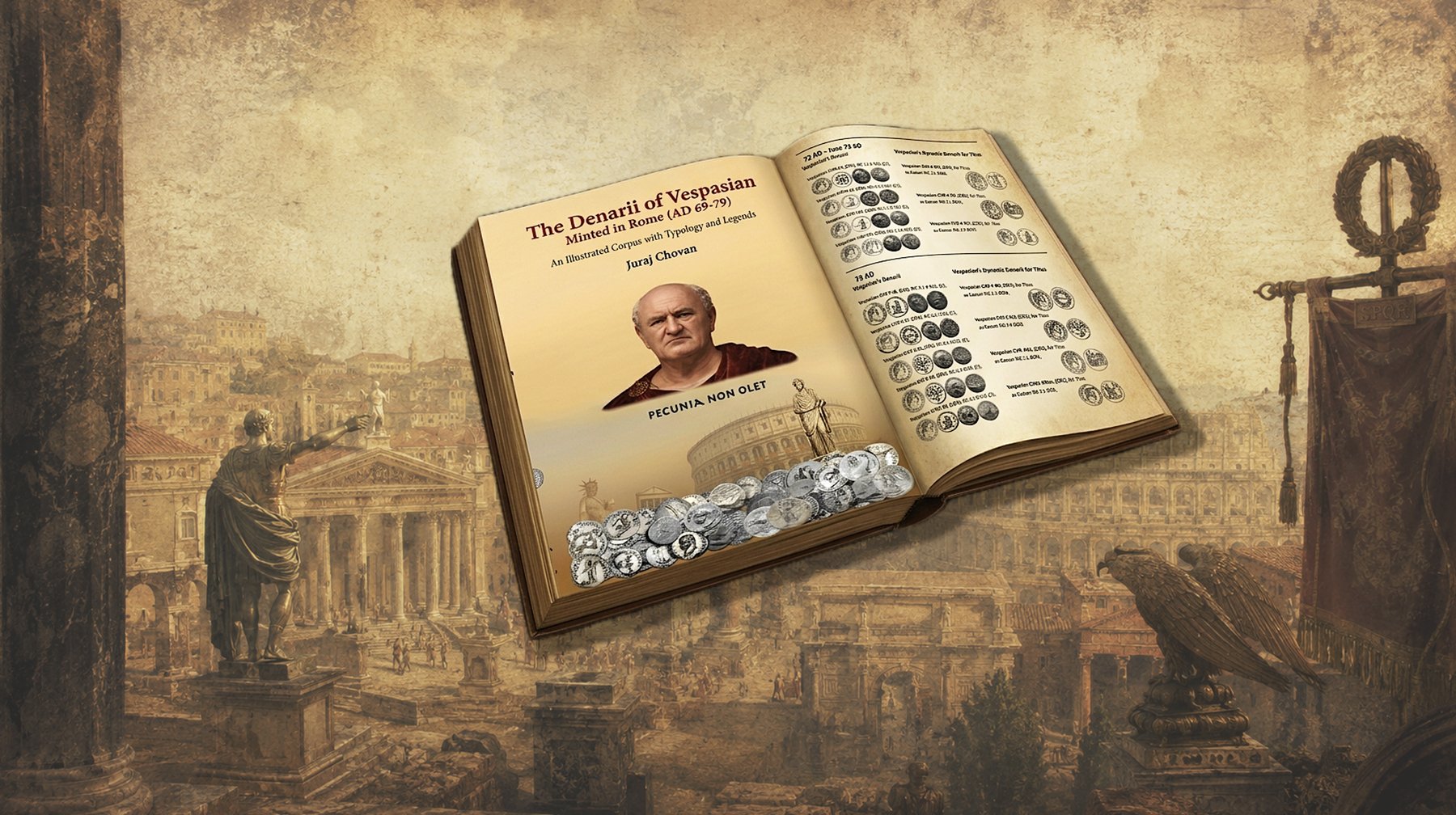
The Denarii of Vespasian, Minted in Rome (AD 69–79) — An Illustrated Corpus with Typology and Legends, by Juraj Chovan, shown as an open hardcover book resting on a view of ancient Rome.

Nine years, one dynasty, and the silver that held it together.

The Denarii of Vespasian is a 504-page reference corpus devoted to the silver denarii struck at the Rome mint during Vespasian’s reign (AD 69–79) — the emperor who ended the civil war of the Four Emperors and, with his sons Titus and Domitian, founded the Flavian dynasty.

Every entry pairs original line drawings and coin photography with commentary on dating, minting context, and the deities and symbols each reverse type invokes, built on the author’s own CR rarity scale and cross-checked against institutional holdings recorded in the Online Coins of the Roman Empire (OCRE) database — the product of years of firsthand market observation as much as archival research.

Hardcover · 504 Pages · 7 × 10 in · Rome Mint, AD 69–79


The Denomination

Restoring an Empire, One Denarius at a Time

The silver denarius was the principal silver denomination of the Roman Empire in the first century AD. During the reign of Vespasian (1 July AD 69 – 23 June AD 79), the denomination played a central role in restoring fiscal order after the civil wars of AD 68–69 and in projecting the legitimacy of the new Flavian dynasty. His reign lasted nine years and nearly twelve months, and throughout this period denarii were struck in substantial quantities at Rome and, during the early years, at an eastern imperial mint generally identified with Ephesus.

Vespasian was the last of the four emperors who governed the Roman Empire in the year 69 AD. The previous three had died either by murder or suicide. Unlike Galba, Otho and Vitellius, Vespasian would die of natural causes in 79 AD. He and his sons, Titus and Domitian, formed what would become known as the Flavian Dynasty.

Look Inside

A Preview of the Corpus

Table of Contents
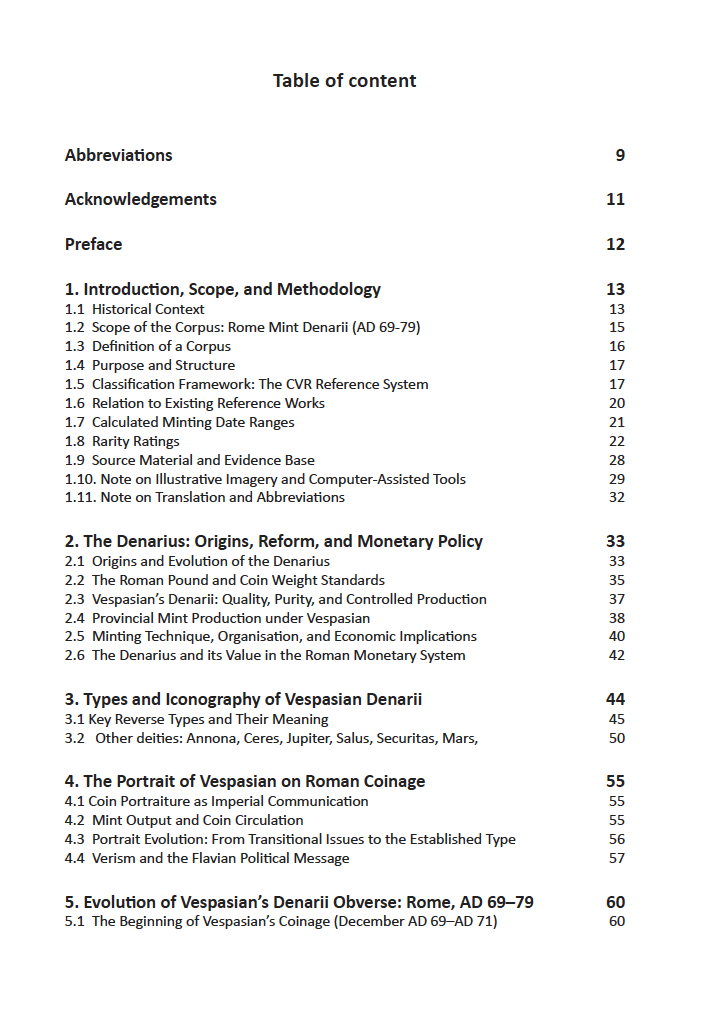
Table of contents, page 1: Abbreviations, Acknowledgements, Preface, and Chapters 1 through 5.
Page 1
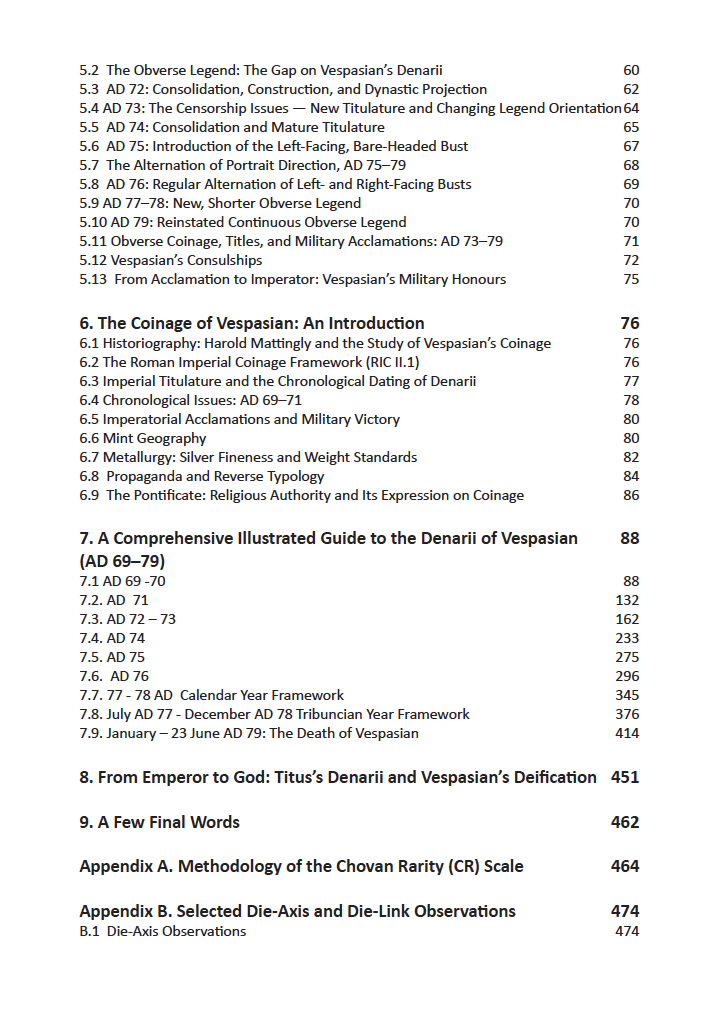
Table of contents, page 2: Chapters 5 through 9, and the start of Appendices A and B.
Page 2
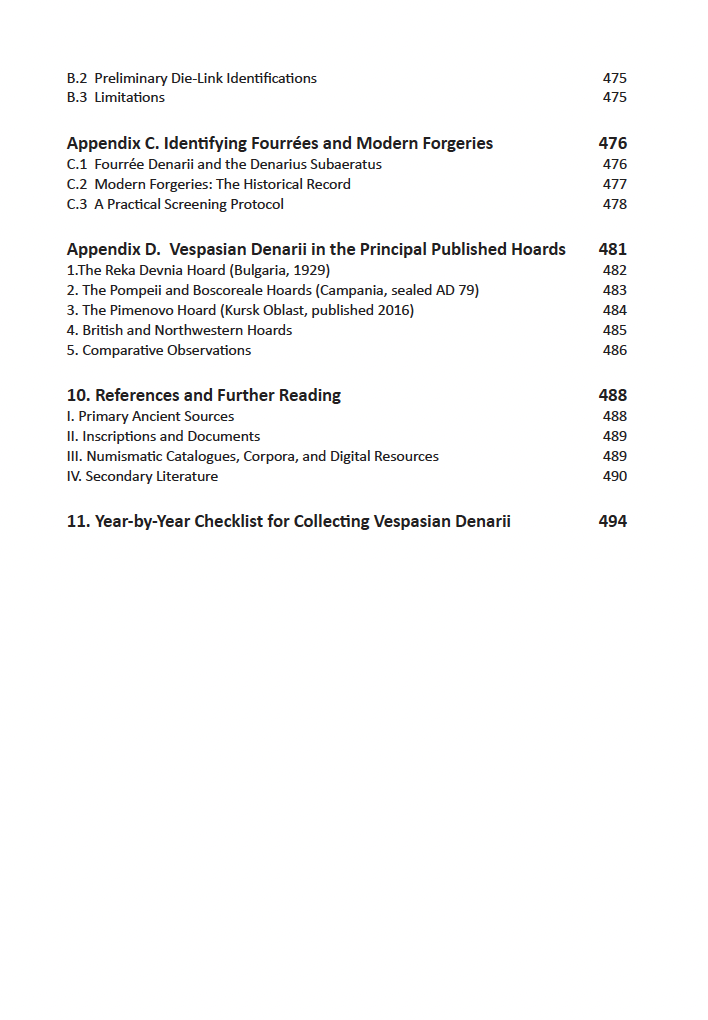
Table of contents, page 3: Appendices C and D, References and Further Reading, and the Year-by-Year Checklist.
Page 3
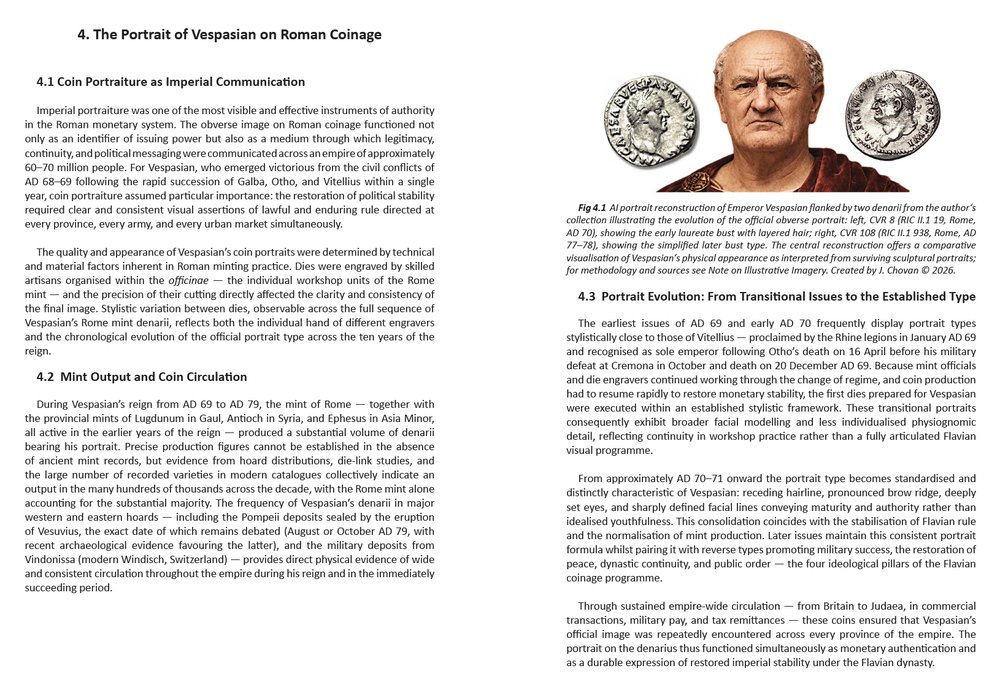
Chapter 4, right-hand page: an AI portrait reconstruction of Vespasian flanked by two denarii, from The Portrait of Vespasian on Roman Coinage.
Chapter 4 The Portrait of Vespasian on Roman Coinage
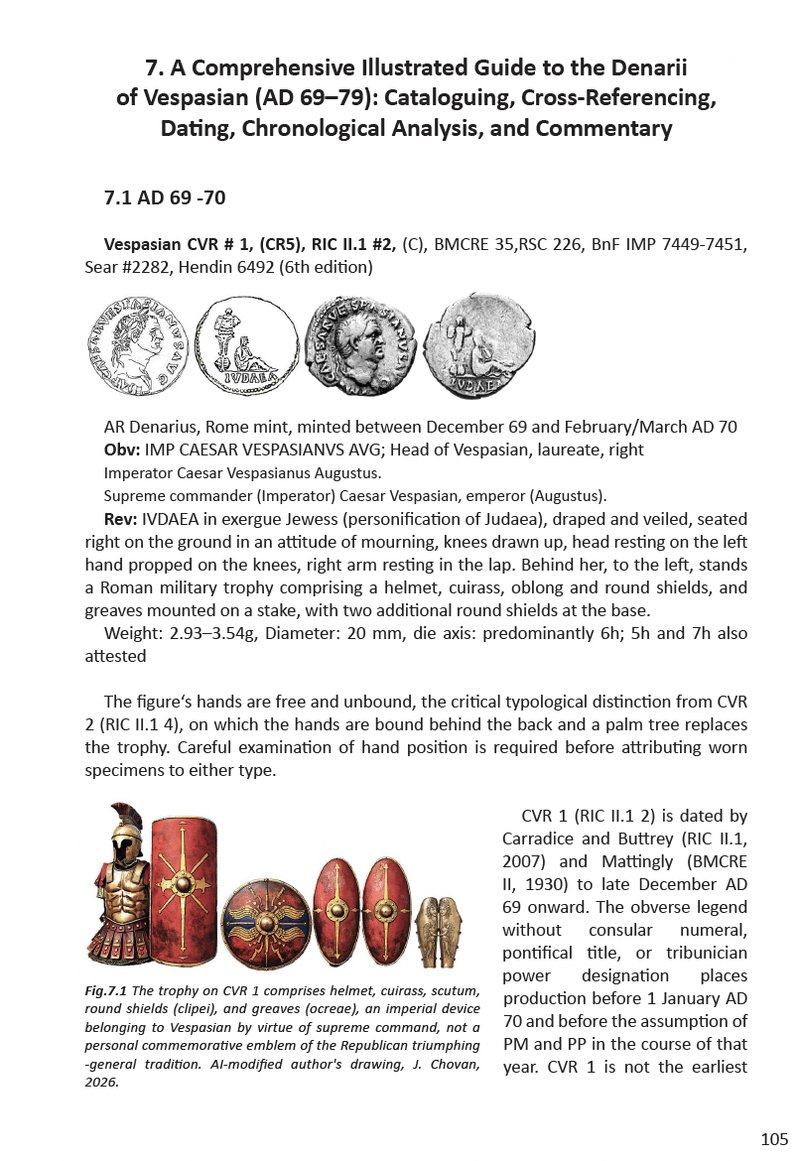
Corpus page 105: illustrated entry for Vespasian CVR 1, RIC II.1 2, with obverse and reverse coin photography and commentary.
Chapter 7 Illustrated Corpus — CVR 1, AD 69–70
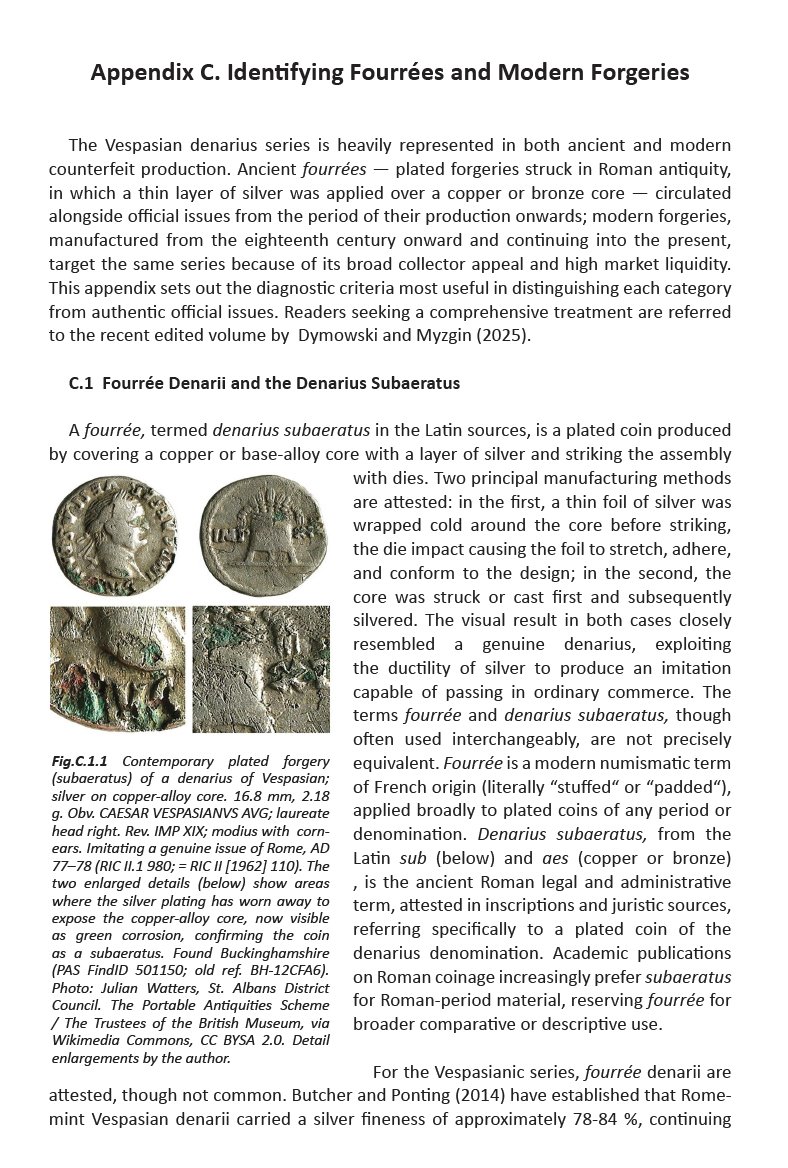
Appendix C: Identifying Fourrées and Modern Forgeries, with a photograph of a plated forgery showing worn silver plating.
Appendix C Identifying Fourrées and Modern Forgeries
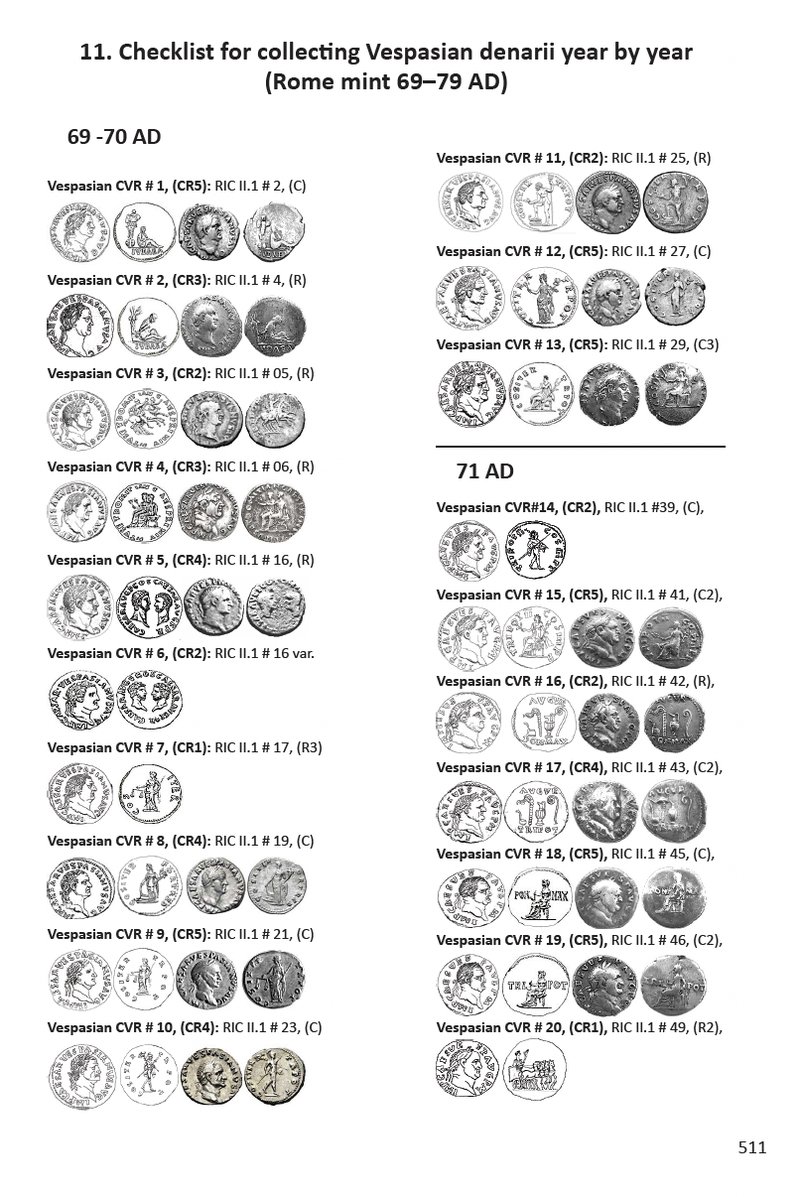
Page 511: Checklist for collecting Vespasian denarii year by year, Rome mint 69–79 AD, with thumbnail images of each coin type.
Chapter 11 Year-by-Year Collector’s Checklist
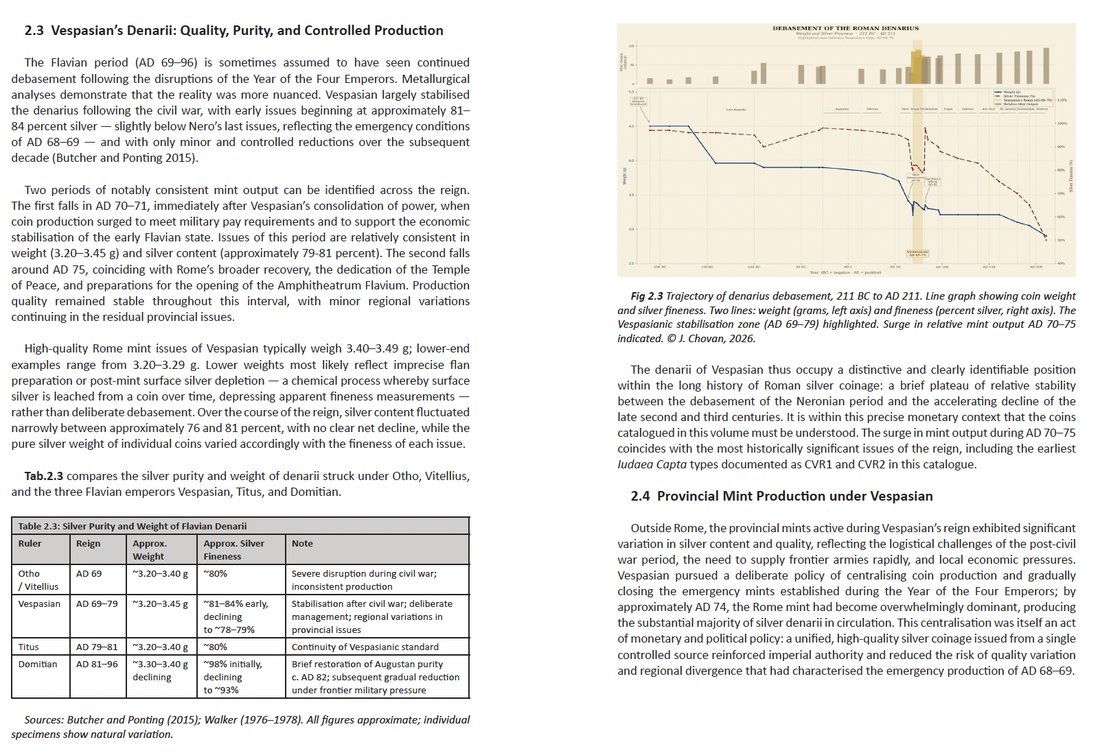
Sections 2.3 and 2.4: Vespasian's Denarii — Quality, Purity, and Controlled Production, with a graph charting denarius debasement from 211 BC to AD 211 and a table of silver purity by ruler.
Chapter 2 Quality, Purity, and Controlled Production
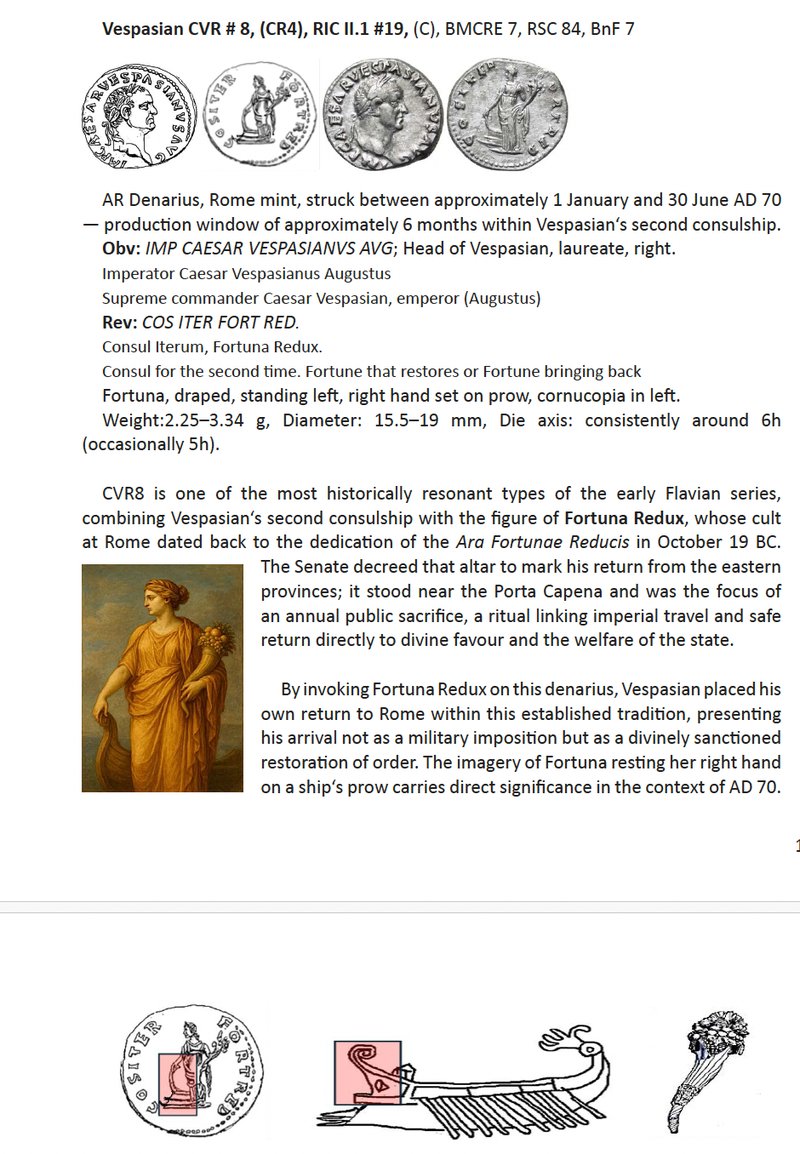
Corpus entry for Vespasian CVR 8, AD 70, Fortuna Redux type, with obverse and reverse coin photography and a painting of Fortuna.
Chapter 7 Illustrated Corpus — CVR 8, AD 70
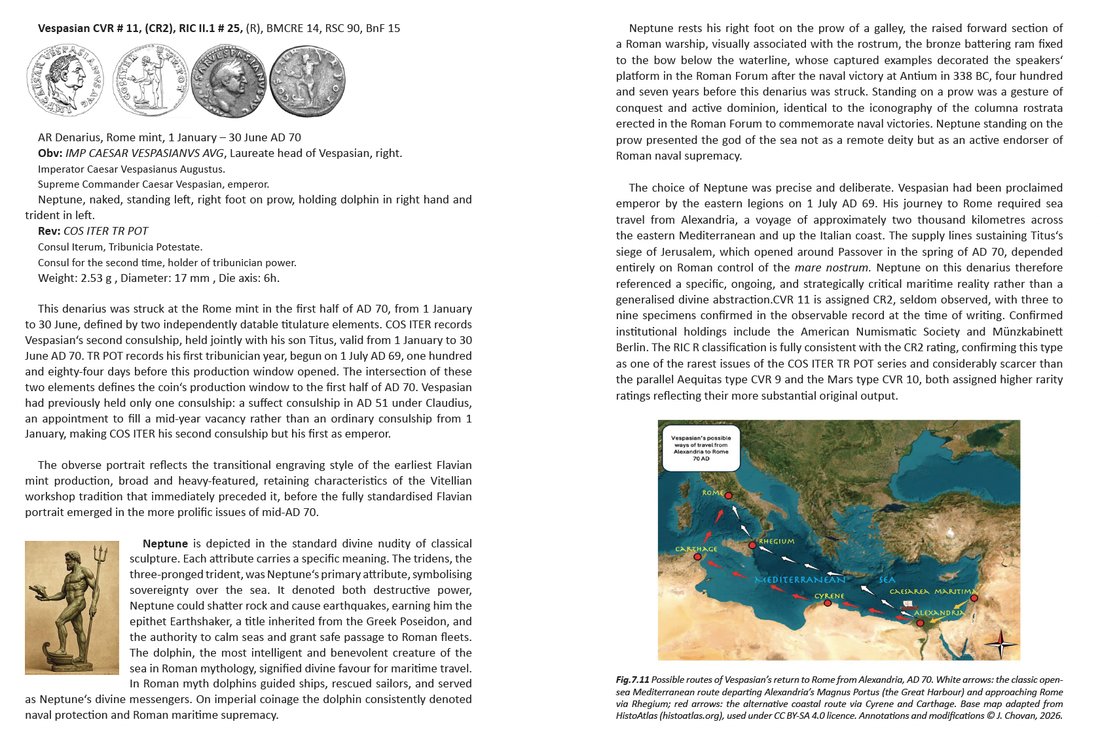
Commentary spread for CVR 11 discussing Neptune's symbolism and a map of Vespasian's possible sea routes from Alexandria to Rome in AD 70.
Chapter 7 CVR 11 — Neptune and the Return from Alexandria
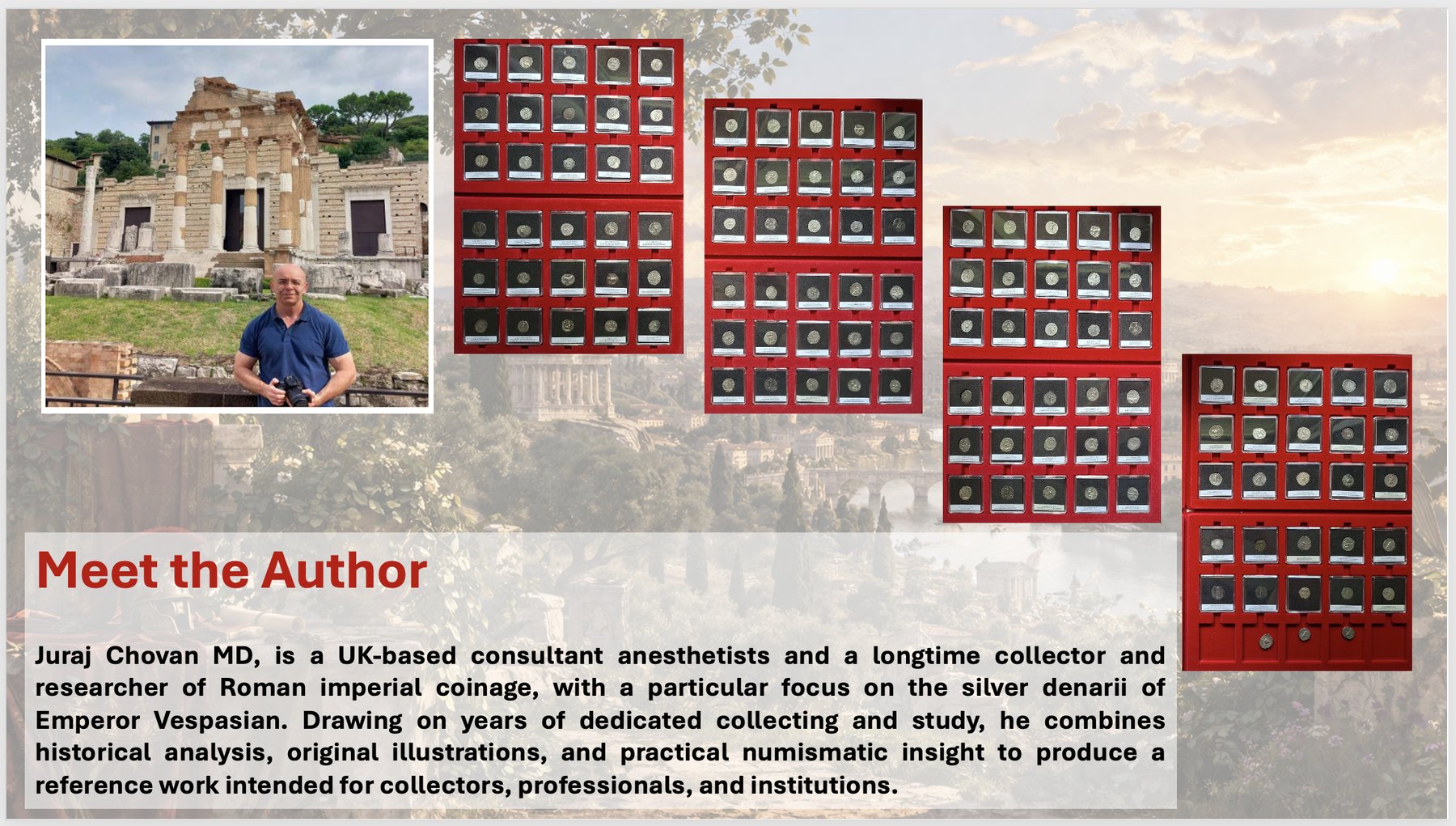
Meet the Author: Juraj Chovan MD, a UK-based consultant anaesthetist and longtime collector and researcher of Roman imperial coinage, pictured at the Capitoline Temple with his coin collection.

Available From

Where to Buy

The hardcover edition is being brought to collectors and institutions through IngramSpark, with Amazon distribution to follow.